
How a padel court is built
Go4Padel team · 20 November 2026 · Reading time: about 8 minutes
A padel court is a steel structure that encloses a 20 × 10 m playing area with walls and steel mesh. The rules of the International Padel Federation (FIP) define its geometry: the height of the walls, the aperture of the mesh, the size of the entrances and the net. What that structure is made of, and how its parts are joined, is down to the manufacturer.
This article takes a padel court apart. It shows what the rules require of the walls, which components make up the structure, what the court stands on, and how the variants differ from one another. The figures come from the FIP rules of padel in force since 1 January 2026 and from the specification of Go4Padel courts.
A padel court in numbers
| Element | FIP rules |
|---|---|
| Playing area | 20 × 10 m (internal dimensions), tolerance 0.5% |
| Clear height above the court | at least 6 m; 8 m recommended in new facilities |
| Back walls | 4 m in total: 3 m of wall and 1 m of mesh |
| Side walls | solid wall over 4 m sections at both ends of the court, steel mesh beyond that |
| Mesh fencing | aperture from 5 to 7.08 cm measured diagonally; wire 2–3 mm recommended, 4 mm maximum |
| Entrances | one or two on each side (or on one side only), symmetrical about the centre of the court |
| Net | 10 m long; 0.88 m high in the centre and 0.92 m at the posts |
| Lines | 5 cm wide; service lines 6.95 m from the net |
| Surface | cement, synthetic material or artificial turf; green, blue or terracotta |
Source: Rules of Padel of the International Padel Federation (FIP), in force since 1 January 2026.
The rules describe what a player sees. What the court is actually made of is set by the manufacturer’s specification. This is how it looks in Go4Padel courts:
| Element | Go4Padel courts |
|---|---|
| Structural steel | S235 |
| Steel protection | AkzoNobel coating system |
| Walls | 12 mm tempered glass |
| Mesh fencing | steel, 50 × 50 mm, 4 mm wire |
| Fixings | AISI 316 stainless steel, Ø14 × 150 mm expansion anchors, PE gaskets |
| Lighting | 4 × 300 W LED fittings; 300 lx indoors, 400 lx outdoors |
| Warranty | 5 years on the steel structure, 5 years on the glass, 3 years on bolted components |
These parameters are shared by both court lines: Go4Padel Core and Go4Padel Precision.
Padel court walls under the FIP rules
The enclosure is part of the playing area. After bouncing on the surface the ball may hit a wall or the mesh fencing and still be in play, which is why the rules set out precisely where the wall ends and the mesh begins.
Back walls
On both short sides the enclosure is 4 m high in total. The lower 3 m is wall; the top 1 m is steel mesh.
Side walls
On the long sides, solid wall occupies 4 m sections at both ends of the court. The rules allow two arrangements:
- stepped wall: the first step is 3 m high and 2 m long, the second 2 m high and 2 m long;
- wall without a step: 3 m high across the whole 4 m section.
Steel mesh forms the rest of the enclosure. At the ends of the court it raises the enclosure to 4 m, and in the middle of each side, over the 6 m on either side of the net, the fencing is 3 m high.
What the walls may be made of
The rules allow both transparent and opaque walls — glass or masonry, for example. There is one condition: the wall must be sufficiently solid and give an even rebound. In Go4Padel courts the walls are 12 mm tempered glass.
What the structure is made of
Load-bearing steel structure
The skeleton of the court is made of steel posts and beams, to which the glass panes and the mesh sections are fixed. The structure determines how rigid the whole enclosure is and whether the walls keep their geometry over years of use, outdoors included. In Go4Padel courts the structure is made of S235 steel and protected with an AkzoNobel coating system. We give a 5-year warranty on the steel structure.
Tempered glass
Glass walls are what makes the game visible from outside the court. Padel courts use tempered glass: it is far more resistant to impact and bending than ordinary glass, and if it does break it falls apart into small pieces with blunt edges. In Go4Padel courts the glass is 12 mm thick and carries a 5-year warranty.
Steel mesh panels
Mesh panels close the middle section of the sides and the upper part of the enclosure. The rules set the aperture, from 5 to 7.08 cm measured diagonally, and the wire thickness: 2–3 mm recommended, 4 mm at most. Go4Padel courts use 50 × 50 mm mesh made of 4 mm wire.
Fixings
Fixings join the structural components, the glass and the mesh, and the whole court is anchored to the ground. Go4Padel courts use AISI 316 stainless steel fixings, Ø14 × 150 mm expansion anchors and polyethylene (PE) gaskets. Bolted components carry a 3-year warranty.
Lighting
The FIP rules require artificial light to be even and not to impair the vision of players, officials or spectators. Television broadcasts and filming need at least 1000 lx of vertical illuminance. Go4Padel courts come with their own lighting: 4 LED fittings of 300 W on steel masts, designed for 300 lx indoors and 400 lx outdoors. We cover the choice of lighting in detail in a separate article: padel court lighting.
Entrances to the court
Entrances are placed in the side walls: on both sides of the court or on one side only, always symmetrical about the centre. There may be one or two entrances on each side. The rules set their dimensions (width × height):
| Arrangement | Smallest entrance | Largest entrance |
|---|---|---|
| one entrance on a given side | 1.05 × 2.00 m | 2.20 × 2.20 m |
| two entrances on a given side | 0.72 × 2.00 m | 1.10 × 2.20 m |
The net and the lines
The net is 10 m long, 0.88 m high in the centre and 0.92 m at the ends, with a tolerance of 0.005 m. It hangs on a metal cable no more than 1 cm in diameter, strung between two posts up to 1.05 m high. The outer edge of the posts coincides with the side boundary of the court.
All lines are 5 cm wide. The service lines run parallel to the net, 6.95 m from it, and the area between the net and the service line is divided in half by the centre service line.
What the court stands on
Traditionally a padel court stands on a concrete slab, to which the structure is fixed with anchors. The surface is laid on top. The rules allow a cement surface, a synthetic material or artificial turf, provided it gives a regular rebound. The colour must be uniform across the court — green, blue or terracotta, or shades of those — and clearly different from the colour of the walls. Go4Padel offers JUTAgrass and MONDO surfaces.
Where a traditional concrete slab is not an option — in a rented hall, for example, or on a floor that must not be disturbed — the court can stand on the Smart Mobile Platform. The court is then anchored to the platform, and the platform itself requires no anchoring into the ground and no drilling into the existing floor.
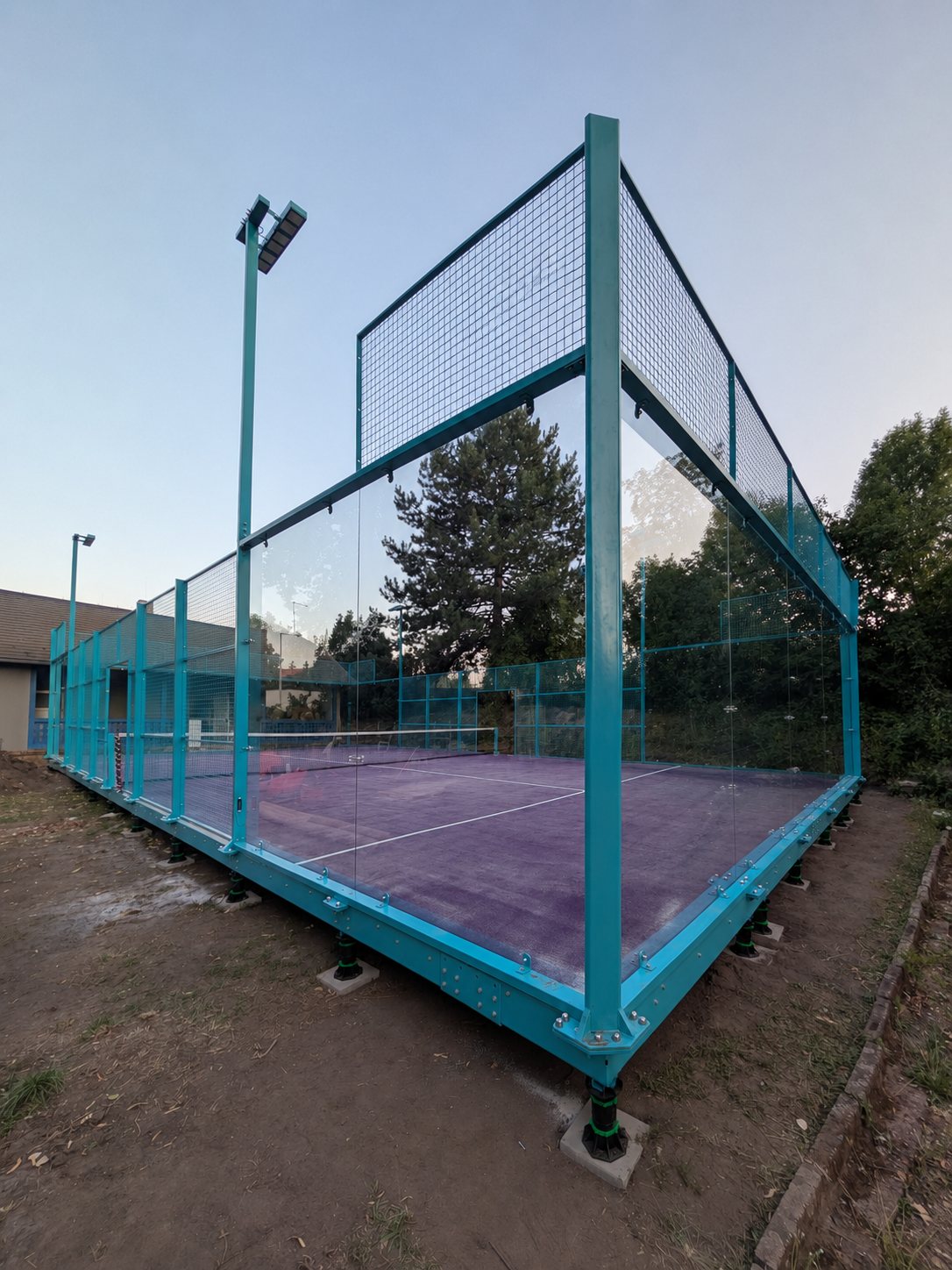
Requirements for the slab under a court and the choice of surface are covered in separate articles in the Knowledge base.
Court variants: standard, panoramic, ultra-panoramic
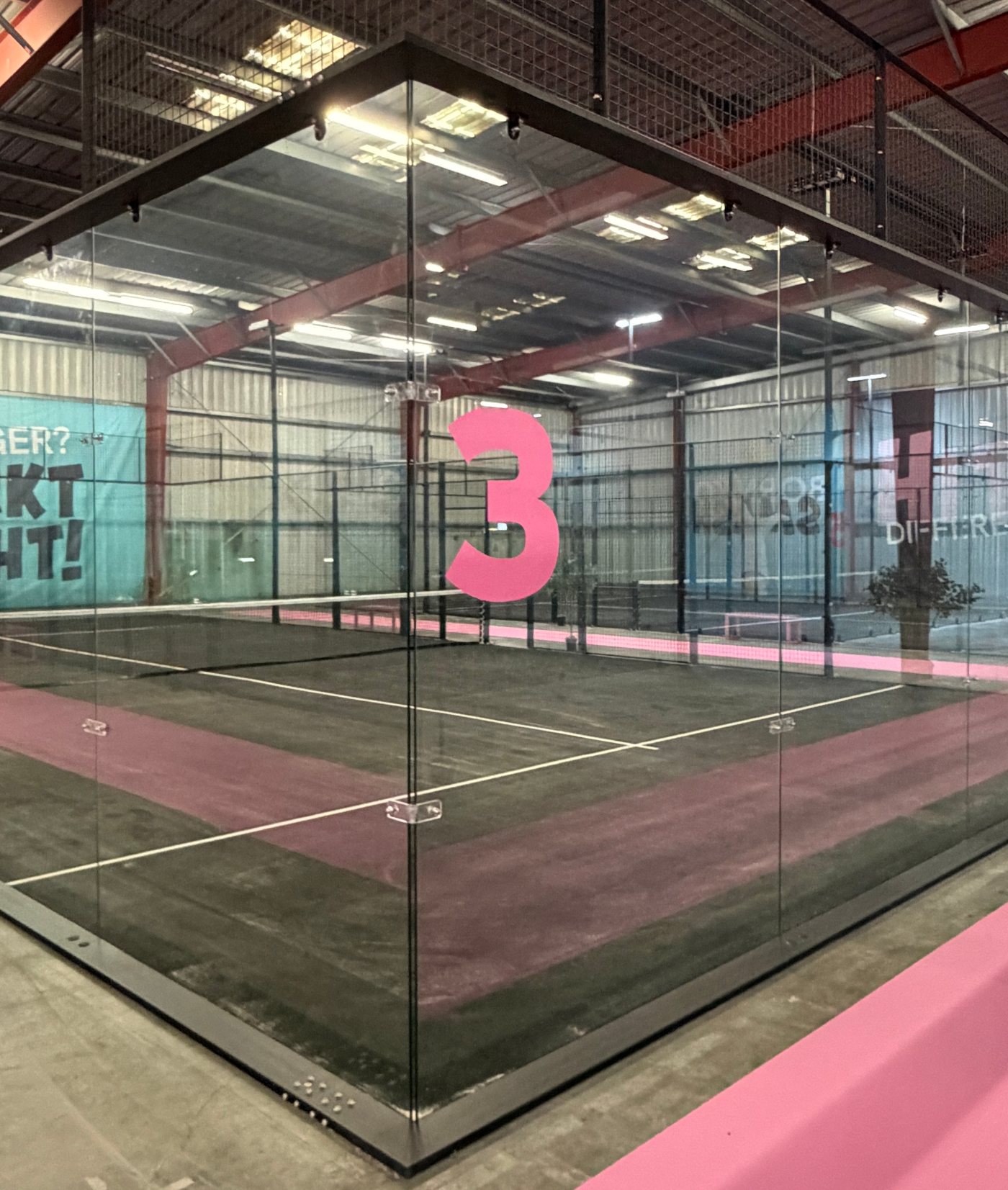
The structural variant decides how much of the court is glazed — that is, how it looks from outside and how well the game can be seen:
- standard court: the classic structural arrangement, available in the Go4Padel Core line;
- panoramic court: a wider span of glazing and markedly better visibility of play from outside, available in both the Core and Precision lines;
- ultra-panoramic court: a structure without corner posts, giving maximum visual openness, available in the Go4Padel Precision line.
The variant is a separate decision from the configuration. Any court can be prepared as indoor or outdoor. You will find the full range in our padel court offer.
Core and Precision: two Go4Padel structural lines
Go4Padel builds courts in two lines. Core and Precision differ above all in the structure and in the way its components are joined. The remaining technical parameters are the same.
- Go4Padel Core is the universal line: versatile and proven. You will recognise it by its distinctive rounded corner profile. Mesh sections are joined with traditional side posts.
- Go4Padel Precision is the line designed with the visual result in mind. Traditional side posts give way to a slender structural joint made of 10 mm steel plate, so fewer components obstruct the view.
These are two design approaches, not two levels of quality: the glass, the lighting and the warranty are identical in both lines.
Planning a padel court?
Go4Padel is a padel court manufacturer. We design, supply and install indoor and outdoor courts in Poland and across Europe. Tell us where the court is to stand and we will match the variant, the line and the configuration to your facility.
Frequently asked questions
What is a padel court made of?
A load-bearing steel structure, walls, steel mesh fencing, the net and its posts, lighting, and a surface laid on prepared ground. In Go4Padel courts the structure is S235 steel protected with AkzoNobel coatings, and the walls are 12 mm tempered glass.
How high are the walls of a padel court?
The back walls are 4 m in total: 3 m of wall and 1 m of mesh. On the sides, solid walls are 3 m high (3 m and 2 m in the stepped version) over 4 m sections at the ends of the court. Mesh raises the enclosure to 4 m at the ends, and in the middle of each side the fencing is 3 m high.
What glass is used in padel courts?
Tempered glass, which resists impact and, if it breaks, falls apart into small pieces with blunt edges. In Go4Padel courts it is 12 mm thick.
What size are padel panels and mesh?
Under the FIP rules the mesh aperture is between 5 and 7.08 cm measured diagonally, with wire of 2–3 mm recommended and 4 mm as the maximum. Go4Padel courts use 50 × 50 mm mesh made of 4 mm wire.
How many entrances does a padel court have?
Under the FIP rules, one or two on each side, placed symmetrically about the centre of the court. Entrances may be on both sides or on one side only.
Does a padel court have to be anchored?
Yes, the structure is fixed to the ground. Go4Padel courts use Ø14 × 150 mm expansion anchors. If a traditional concrete slab is not an option, the court can stand on the Smart Mobile Platform, which requires no anchoring into the ground and no drilling into the existing floor.
What is the difference between a panoramic and a standard court?
The span of the glazing. A panoramic court is more widely glazed than a standard one, so the game is far easier to see from outside.