
Padel court lighting: what you need to know
Go4Padel team · {DATA_PUBLIKACJI} · Reading time: about 7 minutes
Lighting on a padel court has to be uniform and must not dazzle the players. The rules of the International Padel Federation (FIP) require the lower edge of the luminaires to sit at least 6 m above the ground, and television broadcasts need at least 1000 lux of vertical illuminance. For recreational play and regional competition the guidance of the British LTA points to an average of 300 lux, and 500 lux for national and international competition.
Sounds technical? In practice it comes down to two things: the ball should not disappear in a dark corner, and the light should not hit a player in the eyes during a lob. This article explains what those numbers mean, how average illuminance and uniformity are calculated, how lighting differs indoors and outdoors, and what to keep in mind when planning a new facility. The structure that carries the lighting poles is described in our knowledge base.
Padel court lighting in numbers
| Requirement | Value | Source |
|---|---|---|
| Character of the lighting | uniform, without making vision difficult for players, umpires or spectators | FIP |
| Height of the luminaires | at least 6 m from the ground to the lower edge; 8 m suggested in new facilities when the luminaires are installed above the court | FIP |
| Lighting poles | outside the playing area | FIP |
| TV broadcast and filming | at least 1000 lux of vertical illuminance | FIP |
| Recreational play and regional competition | 300 lux average, uniformity 0.5 | LTA |
| National and international competition | 500 lux average, uniformity 0.7 | LTA |
| Calculation grid | 1 m spacing (or finer) across the playing area, centred on the net line | LTA |
Sources: FIP Rules of Padel, in force from 1 January 2026; LTA Padel Court Construction Guidance Note.
What the FIP rules say
The rules of the International Padel Federation (FIP) do not set a single illuminance value for ordinary play. They do set the conditions that any artificial lighting on a court must meet:
- the light must be uniform and placed so that it does not make vision difficult for the players, the umpires or the audience;
- lighting poles must be located outside the playing area; if they stand within the safety area around the court, out-of-court play is not allowed;
- the lower edge of the luminaires must be at least 6 m above the ground; in new facilities, where the luminaires are installed above the court (within the vertical projection of its walls), FIP suggests 8 m;
- television broadcasts and filming need at least 1000 lux of vertical illuminance, and that value can rise with the distance of the object from the camera.
The same 6 m limit (and the 8 m suggested in new facilities) applies to the free height above the whole court. Nothing may intrude into that space, spotlights included. The LTA guidance says the same: fittings are installed so that at least 6 m of clear space remains above the playing area. This matters when choosing a hall, because the luminaires have to hang above that line.
How many lux does a padel court need?
Illuminance is measured in lux (lx). For a court, the figure normally quoted is the average horizontal illuminance — the average amount of light falling on the surface, calculated from many points across the playing area. The guidance of the LTA, which also governs padel in Britain, gives two levels:
| Level of play | Average illuminance | Uniformity |
|---|---|---|
| recreational play and regional competition | 300 lux | 0.5 |
| national and international competition | 500 lux | 0.7 |
Sports lighting in Europe is covered by the standard EN 12193. It divides lighting into three classes: class I for top-level competition, class II for regional and local competition, and class III for lower-level competition, training, school sport and recreation. The required values depend on the sport and the class, which is why a lighting design should be prepared for a specific level of play from the outset.
Broadcasting is a separate matter. A camera sees the players from the side, so what counts is vertical illuminance — the light falling on a vertical plane: the player’s body and the ball in flight. The FIP rules require at least 1000 lux of vertical illuminance for television. If a facility may host broadcasts one day, it is worth allowing for that in the design from the start.
Uniformity and glare
The average alone is not enough. If the middle of the court is bright and the corners are dark, the ball “disappears” in the darker areas. That is why illuminance is quoted together with uniformity, usually as the ratio of the lowest illuminance to the average. A required uniformity of 0.7 means the darkest point of the playing area must carry at least 70% of the average illuminance.
To make those values comparable, lighting is calculated on a grid of points. The LTA guidance recommends points every 1 m (or closer) across the playing area, centred on the net line.
Indoor and outdoor courts
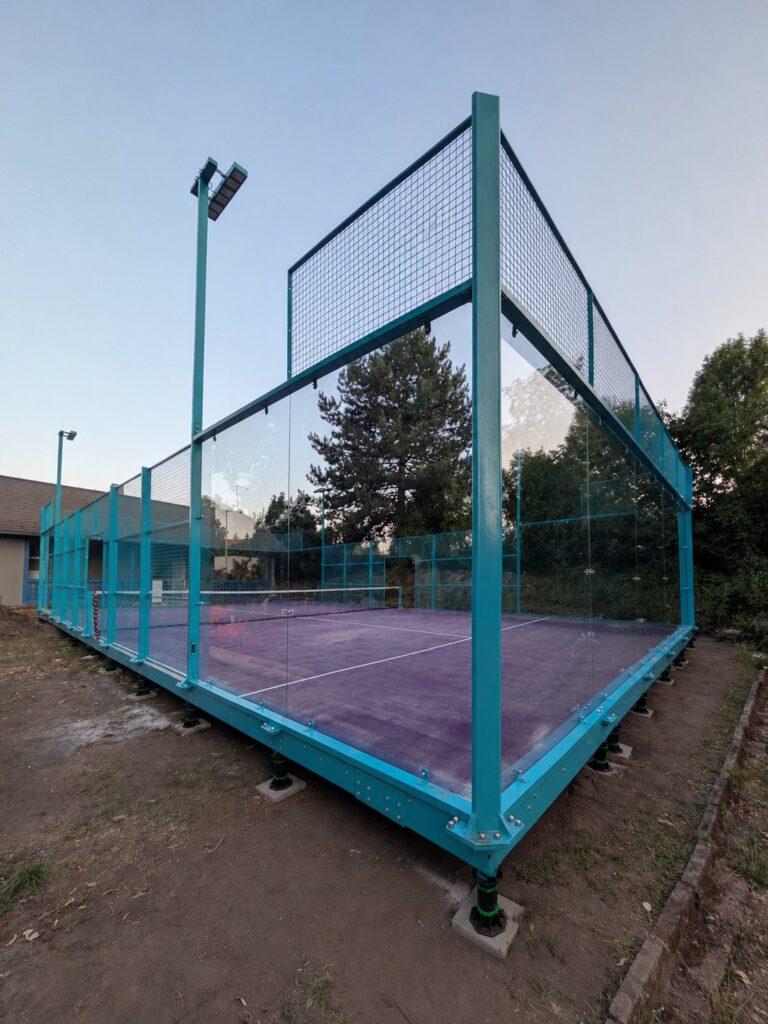
The LTA guidance describes two ways of mounting court lighting: luminaires on the fence posts of the court enclosure — integrated or extended, set 4 m in from the back of the court — or on standalone columns outside the enclosure.
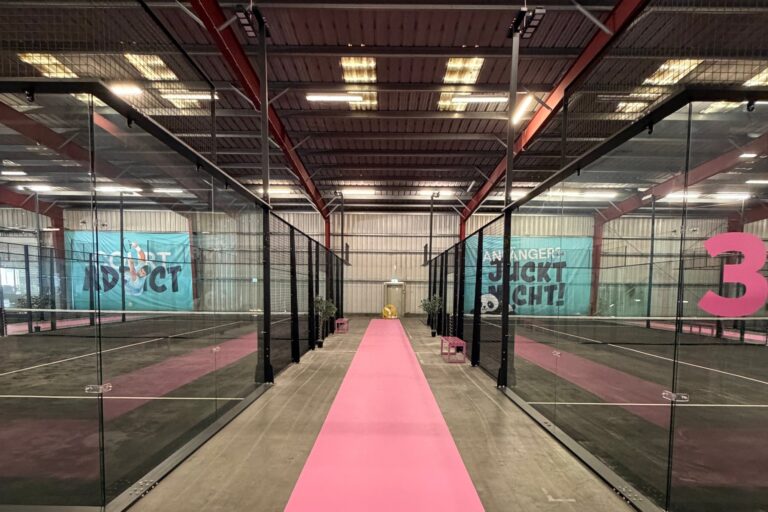
Indoor courts
In a hall there is a third option: lighting suspended from the roof. Whichever solution is chosen, the free space above the court has to remain: at least 6 m, with 8 m suggested in new facilities. Luminaires and other elements must not intrude into it.
Outdoor courts
Outdoors the fittings work in rain, frost and full sun, so they have to be built for it — check the IP rating in the product data sheet. The surroundings matter too: light spilling beyond the court can disturb neighbours, so the direction and tilt of the fittings should be planned with the nearby buildings in mind.
Planning checklist
- Decide the level of play. Recreation and club matches call for different lighting than national competition or broadcasting.
- Check the height of the hall. At least 6 m of clear space above the court, 8 m suggested in new facilities.
- Plan the power supply. The connection and the cable routes to the poles are best allowed for before the base under the court is built.
- Ask for a lighting calculation for your specific facility. The design should show average illuminance and uniformity on a grid of points.
- Outdoors, consider the neighbours. The direction and tilt of the fittings matter for the surrounding buildings.
- Planning to record or broadcast matches? Allow for it in the lighting design and ask about the fittings from the camera’s point of view, flicker included.
Planning a facility with padel courts?
Go4Padel manufactures padel courts. We deliver and install courts in Poland and across Europe. Write to us — we are happy to answer questions about your project.
Frequently asked questions
How many lux does a padel court need?
The guidance of the British LTA gives 300 lux on average (with uniformity 0.5) for recreational play and regional competition, and 500 lux (with uniformity 0.7) for national and international competition. For television broadcasts the FIP rules require at least 1000 lux of vertical illuminance.
How high are padel court lights mounted?
Under the FIP rules the lower edge of the luminaires must be at least 6 m above the ground. In new facilities, where the luminaires hang above the court, FIP suggests 8 m.
Where are the lighting poles installed?
Outside the playing area. The LTA guidance allows fittings on the fence posts of the court enclosure or on standalone columns next to the court. The FIP rules add that if the poles stand within the safety area around the court, out-of-court play is not allowed.
How much electricity does court lighting use?
It depends on the total power of the fittings and how long they run. Energy use in kWh is the power in kW multiplied by the hours of operation. For example, fittings with a total power of 1 kW running for 5 hours use 5 kWh.
Does a court in a hall need its own lighting?
A court in a hall can be lit by fittings on the court structure or by the hall lighting. Either way the required illuminance and uniformity have to be met and the free height above the court kept: at least 6 m, with 8 m suggested in new facilities.
What is lighting uniformity?
It is the ratio of the illuminance at the darkest point of the playing area to the average illuminance. A required uniformity of 0.7 means the darkest point must carry at least 70% of the average.