
Mobile Padel Court — Mobile Platform Smart
Mobile Platform Smart lets you install a padel court without pouring a traditional concrete slab.
Go4Padel manufactures padel courts. Mobile Platform Smart is our solution for projects where the court has to go up faster and without permanent intervention in the site. The court sits on an independent steel structure with adjustable supports — primarily in outdoor applications.
Mobile Platform does not require drilling into the existing floor or anchoring to the ground, and installation takes up to 2 working days.
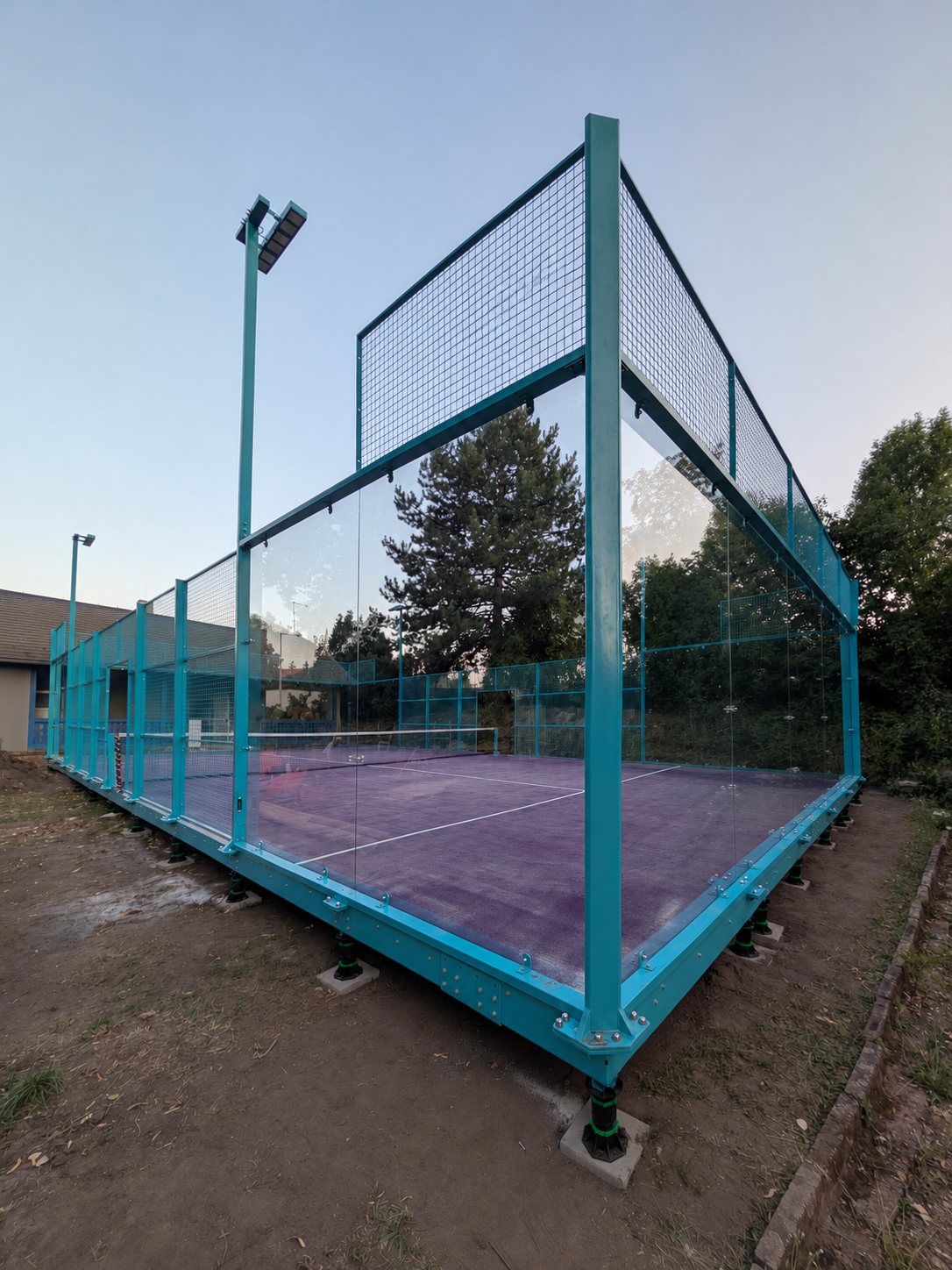
A Go4Padel Core — Panoramic court on Mobile Platform Smart. Project: Prague, Czech Republic.
What is Mobile Platform Smart?
Mobile Platform is a self-supporting steel structure that carries a full-size padel court. It replaces the ground preparation a court would normally need. Smart is the model name of this solution in the Go4Padel range.
Four things set it apart from a standard installation:
An independent structure. Mobile Platform is a load-bearing structure in its own right, not a levelling layer laid over existing ground.
No traditional concrete slab. There is no slab to pour under the court and no curing time to wait out.
No permanent intervention. Mobile Platform does not require drilling into the existing floor or anchoring to the ground.
Reversibility. The structure can be dismantled and reassembled in another location.
A court standing on Mobile Platform is a full-size padel court — not a simplified version and not a substitute structure.
Outdoor applications
Mobile Platform is designed primarily for outdoor use. That is how it is most often used, and where it saves the most time and construction work.
The structure is installed on properly prepared and assessed surfaces such as asphalt, sports surfaces, paving blocks or compacted ground.
In practice the court can often go up on ground that already exists — a yard, a car park, a disused pitch, a compacted area — without pouring a traditional concrete slab underneath.
Adjustable supports absorb unevenness and falls in the ground, so the playing surface stays level even where the ground beneath the platform is not perfectly flat.
We assess every location individually. What decides suitability is not the type of surface but its condition, load-bearing capacity and preparation.
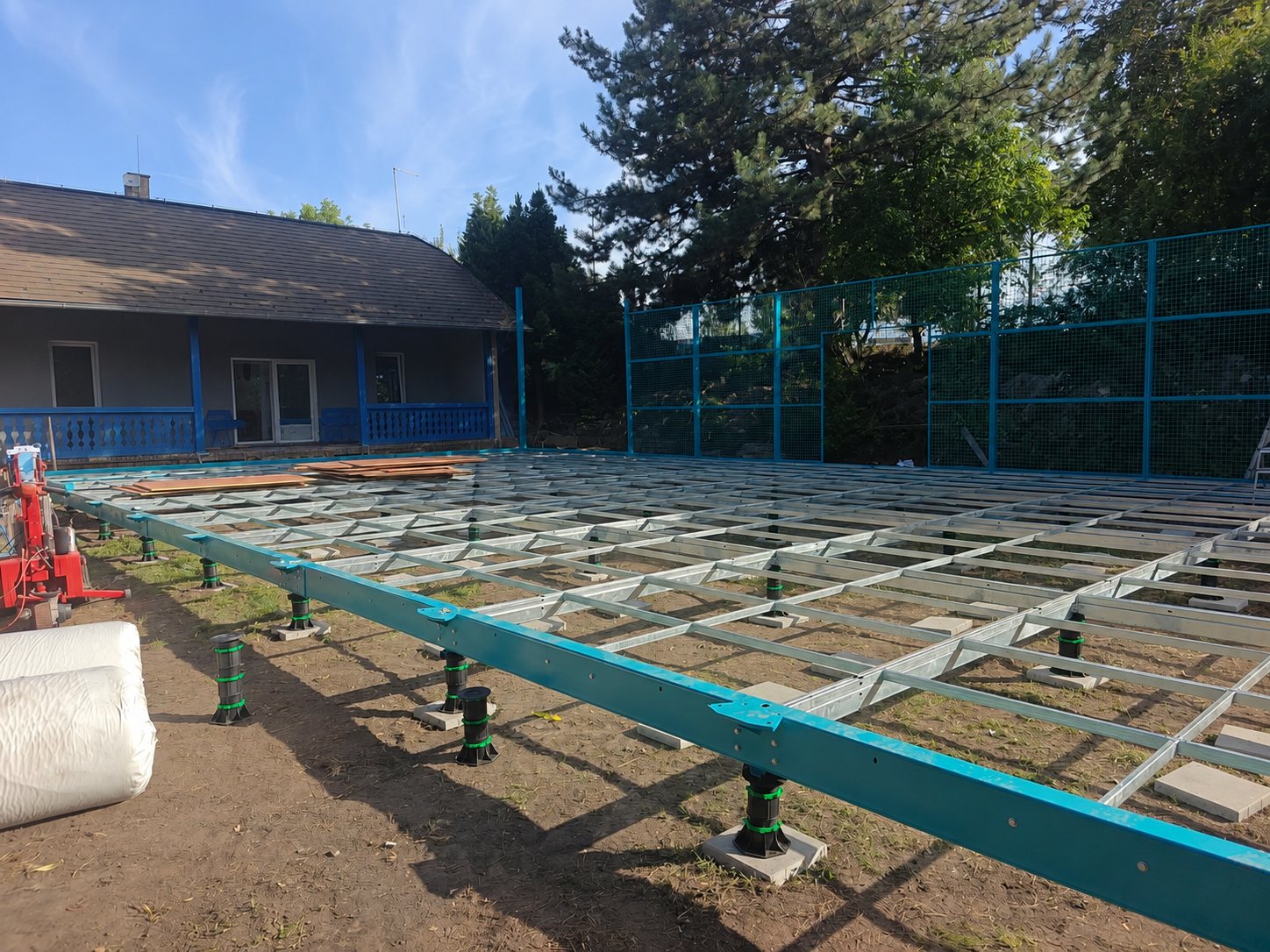
The load-bearing structure of Mobile Platform on adjustable supports, before the plates are laid.
Ground requirements
Mobile Platform does not require a traditional concrete slab, but that does not mean it can stand on any ground. Two conditions have to be met:
Load-bearing capacity. The ground has to carry the load of the structure, the court and its use.
Level differences. Differences in level have to fall within the adjustment range of the supports, from 90 to 1,120 mm.
We assess both for the specific location. They depend on the type and condition of the ground, how the court will be used and how it is configured.
Drainage
Drainage requirements depend on where the platform is installed and on the existing site conditions.
On natural ground, perimeter drainage protection around the platform may be required. A drainage strip around the structure prevents water from collecting and from undermining the ground beneath it.
On hard surfaces the scope is usually smaller, but how water is carried away still needs checking for the specific location. We assess drainage together with the ground, at the quotation stage.
Who is Mobile Platform Smart for?
Padel clubs and sports facilities
Adding padel without permanently rebuilding the site. Particularly useful where a hard surface already exists — a disused pitch, an asphalt court, a yard — which after assessment can be used instead of building from scratch.
Hotels and resorts
A court as part of the guest offer, on existing hard standing, with no earthworks and without taking the property out of use while concrete work is done. At seasonal properties the court can be installed for the season and stored outside it.
Commercial properties
Retail, office and service spaces where a court should appear without permanent intervention in the ground or the floor, and with the option of removing it later.
Private investors
A court on private land where construction work should stay as limited as possible and the owner wants to keep the option of moving it later.
Leased premises
Where the site or building is not yours, permanent construction work is often impossible or needs consents that cannot be obtained quickly. Mobile Platform does not interfere with the fabric of the property.
Events, activations and seasonal capacity
The structure is built to be dismantled and reassembled, so the same court can be used again and again — at successive events, in successive seasons, or in another spot on the same site. For organisations running such events regularly the court stays their own asset.
How Mobile Platform is built
The structure works as a single load-bearing system made up of six layers. From the top:
1. Padel court with its surface
2. Composite plates, 20 mm thick — forming a level surface under the court
3. Load-bearing modules, 2.0 × 2.5 m
4. Internal and side beams — the grid that carries the loads
5. Adjustable supports — establishing a single reference plane
6. Prepared ground
The adjustable supports are the key element. They are what produces one level plane even where the ground beneath the platform is not even — and they are what replaces levelling the ground by construction methods.
Technical data
The parameters below come from the technical documentation for Mobile Platform Smart.
| Parameter | Value |
|---|---|
| Adjustable support height | 90–1,120 mm |
| Support points | 103 in the reference configuration (110 supplied, +5%) |
| Load-bearing modules | 40 units, 2.0 × 2.5 m |
| Composite plates | 80 units, 1.25 × 2.0 m, 20 mm thick |
| Side beams | Q235B steel, 100 × 200 × 3.0 mm |
| Corrosion protection | hot-dip galvanised |
| Support service life | up to 10 years |
| Installation time | up to 2 working days |
These values describe the reference configuration. Final sections, component quantities, the method of support and load verification are determined individually for each project.
Hot-dip galvanising matters precisely because of outdoor use — the structure works in the weather all year round.
Installation in up to 2 working days
Installing Mobile Platform takes up to 2 working days.
This is the most practical difference against building a court on a traditional concrete slab. There the schedule is set by earthworks, pouring the slab and waiting for the concrete to cure before court installation can even begin. Here the structure goes up within two working days, and the site is not out of use for weeks.
Installation runs in six stages:
1. Survey and setting out of the support points.
2. Positioning and fixing the supports at the required height.
3. Installing the side and internal beams — forming the load-bearing grid.
4. Connecting the load-bearing modules into a single system.
5. Laying the plates that form the surface under the court.
6. Quality control of the whole structure.
Control point: work does not continue until the support heights, the outline dimensions and the level of the beam grid have been verified. An error at this stage carries through the entire structure.
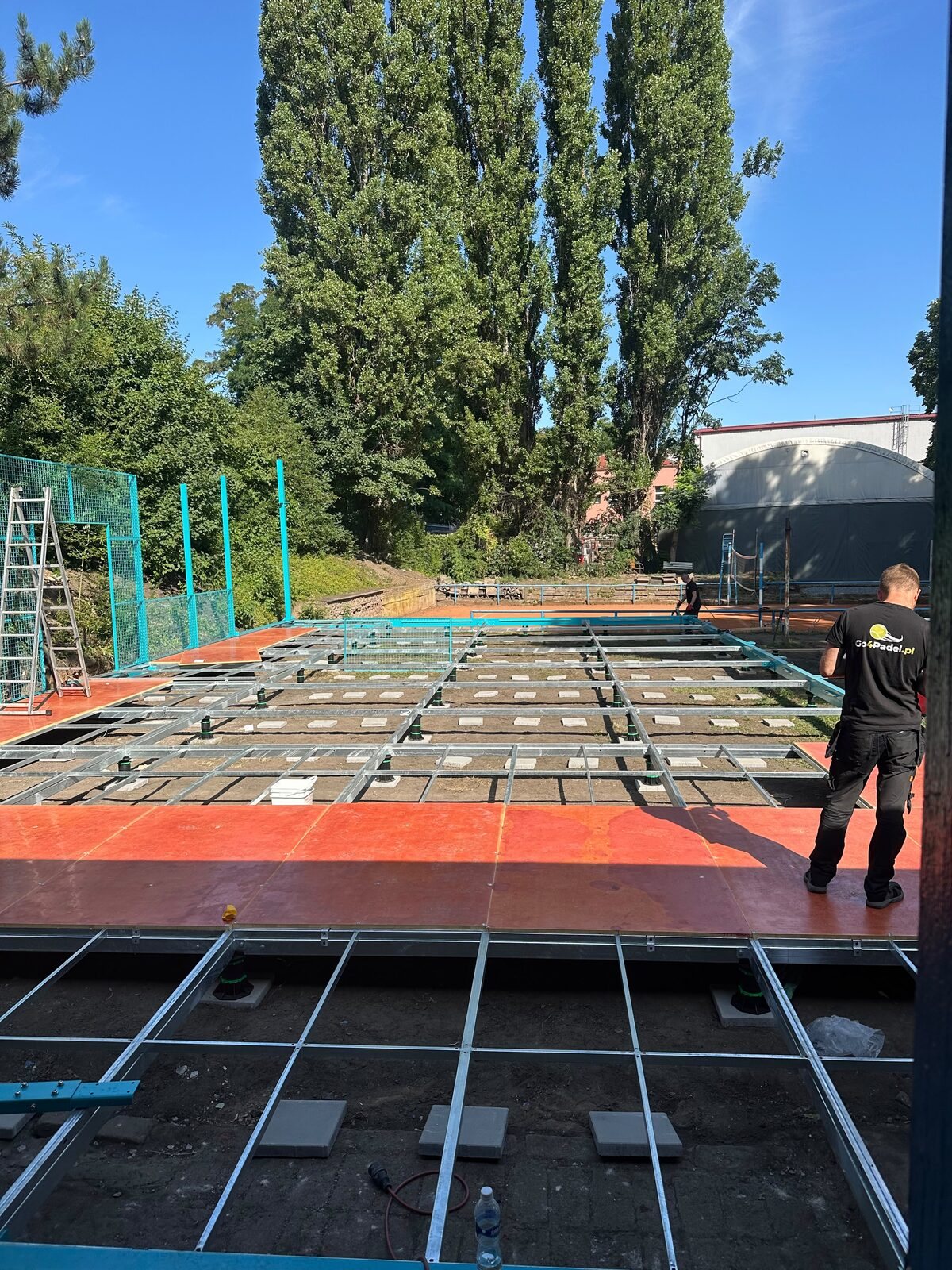
The Go4Padel team laying the composite plates of Mobile Platform.
Dismantling, relocation and stability
The structure is built to be dismantled and reassembled in another location. That is what makes a court on Mobile Platform independent of one fixed spot — it can come back for another season, another event, or move with the property.
Structural stability
Worth saying plainly, because every investor asks.
Individual modules that are not connected to one another can shift and generate noise under local dynamic load. Only connecting the modules into a single load-bearing system produces a stable base — and that is exactly how the platform is installed.
Court dimensions
A court installed on Mobile Platform keeps the dimensions set out in the rules of the International Padel Federation (FIP): a 20 × 10 m playing area for a double court, with permissible surface unevenness of 3 mm measured with a 3-metre straightedge. The adjustable supports are what makes the required levelness of the playing surface achievable.
Reference project: Prague, Czech Republic
Mobile Platform Smart has been delivered in Prague, in the Czech Republic. The platform carries a Go4Padel Core — Panoramic court with a Juta Grass surface.
The photographs on this page come from that project: the finished court, the load-bearing structure on its adjustable supports before the plates were laid, and the Go4Padel team during installation.
The project shows the typical case: an outdoor site, supports set on prepared bearing points, and a full-size court ready to play on — without pouring a traditional concrete slab under it.
Mobile Platform compared with a court on a traditional concrete slab
| Court on Mobile Platform | Court on a traditional concrete slab | |
|---|---|---|
| Traditional concrete slab | not required | yes |
| Ground preparation time | preparing and assessing the site | earthworks, pouring the slab, curing the concrete |
| Structure installation time | up to 2 working days | after the concrete work is finished |
| Drilling into the existing floor | not required | usually yes |
| Anchoring to the ground | not required | usually yes |
| Intervention in the property | reversible | permanent |
| Dismantling | yes | limited |
| Relocation | yes | no |
| Leased site | suitable | usually problematic |
| Permanent, long-term installation | possible | the typical solution |
The choice is not about which solution is „better”. It is about whether the investment should be permanent and tied to one place, or reversible and movable.
What we need to prepare a quotation
• the location and access conditions
• the type, condition and load-bearing capacity of the existing surface or ground
• the required platform height and reference level
• site conditions and how water is carried away
• the court configuration
• installation conditions on site
The more of this you give us up front, the sooner you get a concrete quotation rather than a range.
Frequently asked questions
Is a mobile padel court full size?
Yes. A court on Mobile Platform keeps the 20 × 10 m dimensions set out in the FIP rules.
Is a court on Mobile Platform suitable for outdoor use?
Yes — outdoor use is what Mobile Platform is primarily designed for. The structure is installed on properly prepared and assessed surfaces such as asphalt, sports surfaces, paving blocks or compacted ground. It is hot-dip galvanised, which protects it in the weather.
How long does installation take?
Up to 2 working days. There is no traditional concrete slab to pour beforehand and no curing time to wait out, so the schedule loses an entire stage of construction work.
Is drainage necessary?
It depends on where the platform is installed. On natural ground, perimeter drainage protection around the platform may be required — a drainage strip that stops water collecting and undermining the ground. On hard surfaces the scope is usually smaller, but we still check how water is carried away for the specific location.
Does installation require drilling into the floor?
No. Mobile Platform does not require drilling into the existing floor or anchoring to the ground.
Can the platform be dismantled and moved?
Yes. The structure is built to be dismantled and reassembled in another location.
Can Mobile Platform be used for seasonal installations or event infrastructure?
Yes. The structure is built to be dismantled and reassembled, so a property can install the court for a season or for an event, then take it down and use it again. The court stays the property’s own asset and can come back on later occasions.
How much unevenness in the ground can be levelled out?
The supports adjust from 90 to 1,120 mm. Whether that works at a specific location is assessed from the shape and load-bearing capacity of the ground.
What is the platform made of?
A hot-dip galvanised steel structure: adjustable supports, a beam grid, load-bearing modules and 20 mm composite plates.
Is the structure stable?
Yes — provided the modules are connected into a single load-bearing system, which is exactly how it is installed. Individual, unconnected modules can shift under local load.
Let’s talk about your project
Tell us where the court should go, what surface it will stand on and how you plan to use it. We will check whether Mobile Platform Smart is the right solution — and if it is not, we will say so and tell you what would be better.